Robotics · AI · Automation — September 15, 2026
Old Gears, New Ideas
Automating the machines the world already owns
In October 2020, after years of testing, Waymo made their Waymo One platform available to the general public in Phoenix, Arizona.1 It was the first time the average citizen could pay to be transported by a Level 4 self-driving vehicle: fully autonomous with no safety driver.2 It was rightfully treated as a landmark moment in automation history.
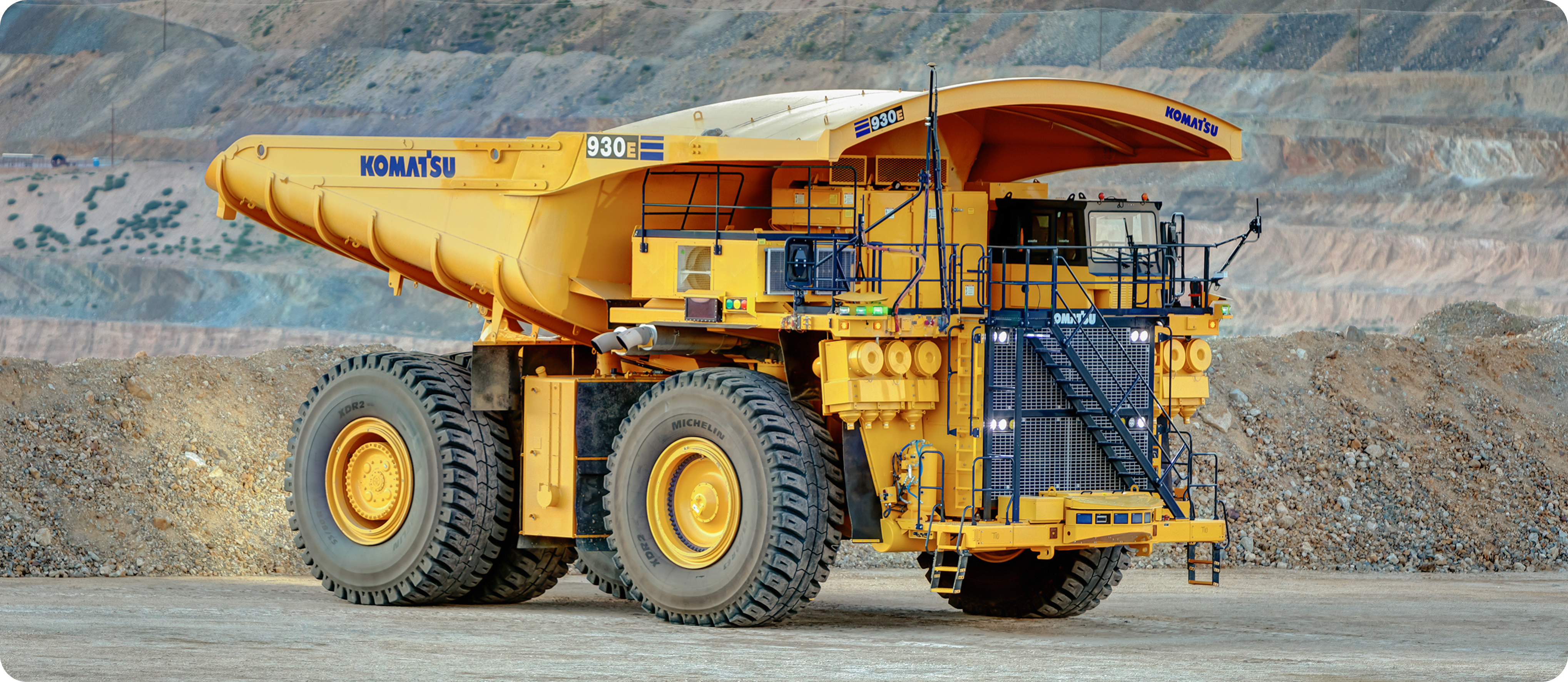
At the time, commercially deployed autonomous vehicles were nothing new. Twelve years earlier, the Japanese heavy equipment manufacturer, Komatsu, had already achieved their “Waymo One” moment. In early 2008, four Komatsu FrontRunner autonomous haulage systems (AHS) went live at Codelco’s Gabriela Mistral copper mine in Chile.3 Huge driverless haul trucks moving real material, paid for by a real customer. Outside of the mining industry, nobody really noticed.
Autonomy Arrives Slowly
The lesson is autonomy first arrives where the environment is structured and the labor economics are harsh. It also arrives slowly. The current global installed base of ≥90mt mining trucks is ~86,000 units.4 Nearly nineteen years on from the first commercial autonomous solutions, only ~5,000 of them are autonomous.5
While the world’s heavy equipment fleet is largely un-automated; it isn’t un-instrumented. The instrumentation is just pointed at the wrong thing. Telemetry platforms like Caterpillar’s VisionLink connect more than 1.5 million of its own (and its competitors’) off-highway assets.6 Every one of those assets is doing repetitive physical work in a semi-structured environment, but almost none of that work is being captured in the form that can train new AI models.
A retrofit closes that gap: an autonomy kit of sensors and compute, bolted onto an existing machine in hours and fully reversible. It is usually discussed as a software distribution strategy: a way to reach an installed base that turns over every ten to fifteen years. We think that undersells it. It is now industry consensus that physical AI’s scarcest and most valuable resource is data. Selling a solution that automates pre-existing hardware is not only a capital-efficient way of accelerating physical AI adoption, but also the only strategy that gets paid for collecting training data.
Everyone Else Buys Their Data
Every hour of physical interaction data has to be manufactured from scratch, and it is priced accordingly: teleoperation hours trade anywhere between $15 and $40, which pushes the pure data costs of scaling a VLA-style model well onto the ten-figure range.7 If you don’t already own the infrastructure that generates this data, you need to pay for it by the hour.
Retrofitting autonomy onto old equipment is the way around this: the machine already exists, the operator is already working, and the customer is already paying for the output. Bedrock Robotics’ supervised deployment across a 130-acre Sundt Construction site moved over 65,000 cubic yards of material.8 Those were billable hours and a training set at the same time.
Built Robotics has been running this model since 2016. Its Exosystem kit makes a manually operated excavator autonomous, and has gone onto Caterpillar, Hitachi, John Deere and Volvo machines. The infrastructure that makes a machine autonomous is the same infrastructure that records what it did. Built has since pointed the stack at one job, solar piling, where a two-person crew places roughly 300 piles a day against about 100 conventionally.9
Data collection is not completely free though. Supervised autonomy means paying a remote operator across a number of machines, and the data is only free when profit on the work covers that cost. WeRide’s supervision ratio of one operator to forty machines covers it easily, but remote construction’s typical supervision ratio of 1:3 does not.,1011 This is still better than purchasing pure teleoperation data, where the subsidy is bounded by a fundraise rather than revenue.
Whether this model can be run at all depends on two things: how structured the environment is; and who actually owns the machines that are being automated.
Fragmented Means Unclaimed
The semi-structured nature of a mine site is why the industry got autonomy twelve years before consumer vehicles did. Haul roads are mapped, repetitive, and closed to the public.
But we also think mining is the worst place to fund an independent retrofit company.
Industry incumbents Caterpillar and Komatsu own the fleet, the dealer network and the customer: Komatsu commissioned its 1,000th ultra-class autonomous truck in April 2026; Caterpillar ran 690 at the end of 2024 and targets 2,000 by 2030.1213 Mixed-fleet retrofit was proven here. Epiroc and ASI Mining converted 96 trucks across four models from two manufacturers at the Roy Hill iron-ore mine in Australia before Epiroc completed its acquisition of ASI in 2024.14 Deere & Company (John Deere) ran the same play in agriculture, paying $250M for Bear Flag Robotics in 2021 and now shipping its own autonomy kit for existing 8R and 9R machines.15
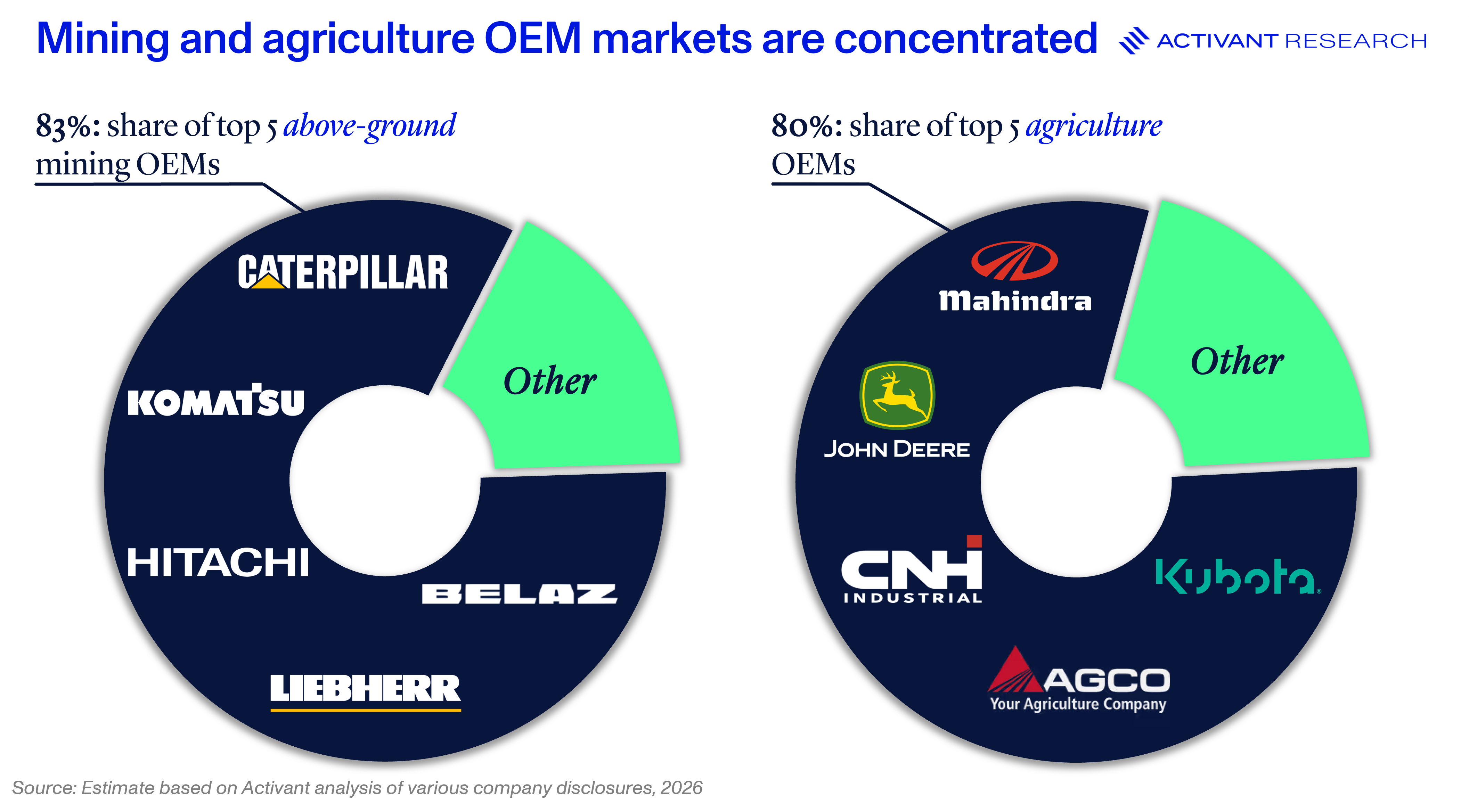
In concentrated verticals like mining and agriculture, independent retrofit companies get acquired by incumbent OEMs.16 It has happened twice now, and both times the OEM was the only buyer who really needed the business. John Deere paid $250M for Bear Flag, which is a great result for a seed-stage investor, but a lukewarm one for anyone who backed the company as a data-compounder. This puts a ceiling on the returns a growth-stage investment in an independent retrofit company can generate. Deere bought the technology for its own tractors, not a business that automates everyone else’s.
Construction is the inverse. It is the hardest environment in the category: jobsites reconfigure daily, and people and machines move unpredictably. But it is where the independent retrofit companies operate: Bedrock Robotics, Built Robotics, Gravis Robotics, Hive Autonomy, and TerraFirma. These companies have emerged not because construction is easy, but because no single OEM controls the customer, let alone the data exhaust.
Consolidation has started here too, though not the same kind: Pronto acquired SafeAI in 2025, which was subsequently acquired by Atoms earlier this year, and Havoc acquired Teleo in 2026.171819 None of these buyers actually manufacture equipment. The OEMs have stayed out. None of them controls enough of this fleet to be worth defending.
So, the first thing we look for is OEM-agnosticism. Gravis Robotics supports more than a dozen brands, including HD Hyundai Develon, CNH and Menzi Muck, and SoftBank put $200M into it as sole investor at a $1B Series A valuation.20 A retrofit product that only fits one manufacturer’s machines is a roadmap item for that manufacturer.
A fragmented fleet still has one concentrated way in. Rental accounts for 55–60% of the North American equipment market and 65–80% in Europe, the UK and Japan; United Rentals, Sunbelt and Herc hold about 30% of the US between them.21 Rental fleets also standardize on one or two suppliers per product range, so integration cost falls with each unit. Gravis is already there, fitting kits to excavators for Flannery, the UK’s largest plant hire firm. Every one of those machines is already sending data to its manufacturer.
Telematics Is Not Training Data
Telemetry platforms stream engine hours, fault codes and utilization of every connected machine, owned, rented or leased. But telematics and training data are different products: fault codes tell you a machine’s health, not what the operator saw or what they did about it. The window is one product decision wide, and no OEM has made it.
Our biggest concern is that one day, real data may not be the constraint in scaling autonomy to general purpose capability. The environments we have been discussing have simple, repetitive geometry, which is what simulation and synthetic data handle best. If an autonomy stack can be trained largely in simulation and fine-tuned on a few thousand real hours, a fleet’s recorded data is a head start rather than a moat. We would not back a company for that data alone. The version worth owning has the data and a customer base already running the kit.
What would change our mind is supervision ratios still at 1:3 by 2028, and any OEM shipping a perception-grade data product on its telematics base. Assuming the argument holds; turning it into money is a separate problem.
Chasing a 45-Point Spread
Retrofit turns a once off hardware sale into a recurring loop: Collect, train, deploy, collect again; and it could unlock the path from 30% commodity gross margins to 75% software margins for OEMs.2223
Bedrock raised $270M at a $1.75B valuation selling autonomy as a service, keeping the revenue and the data.24 Built’s Blattner agreement does the same in a narrower vertical.25 TerraFirma raised roughly $115M to own the machines and sell finished sitework, taking the whole project margin and the capital intensity with it.26
We think most players will drift toward the TerraFirma model without meaning to. If per-site integration cost does not fall, project margin is the only way to pay for it. The software business you back today may be a contractor by the time you exit.
Read The Data Rights Clause
In retrofit, the data is generated on someone else’s machine, on someone else’s site, during work someone else is paying for. So, who owns the logs?
It is a contract question, and it determines whether there is a loop at all. If the customer owns the exhaust, the retrofit vendor has a services business with no compounding asset, however good the kit. If the vendor owns it, or holds a perpetual license to train on it, the same deployment produces a data position competitors cannot buy at any price. Same revenue, same install, same hardware, entirely different business.
The rental channel makes this sharpest. A rented machine generates data three parties can claim: the vendor, the hire company and the contractor running it.
We would put that clause ahead of the autonomy demo in diligence. The question is not how good the perception stack is. It is who owns what the machine saw.
Neither the kit nor the machine it’s bolted to is the real asset. The asset is being paid to learn.
Footnotes
-
Waymo, Waymo is opening its fully driverless service to the general public in Phoenix, 2020 ↩
-
SAE International, SAE J3016™ Recommended Practice: Taxonomy and Definitions for Terms Related to Driving Automation Systems for On-Road Motor Vehicles, 2014 (refined in 2021) ↩
-
Komatsu, Komatsu celebrates 10th anniversary of commercial deployment of Autonomous Haulage System (AHS), 2018 ↩
-
Parker Bay Mining, Mining Equipment Database, 2026 ↩
-
Estimate based on Activant analysis of various company disclosures, 2026 ↩
-
Caterpillar, Caterpillar brings intelligent solutions to life at CONEXPO-CON/AGG 2026, 2026 ↩
-
Activant expert network ↩
-
Engineering News Record, Bedrock Robotics Excavators Remove 65,000 Cubic Yards of Dirt on Southwest Project, 2025 ↩
-
Activant expert network ↩
-
Activant expert network ↩
-
Komatsu, Komatsu becomes first OEM to commission 1,000 ultra-class autonomous haul trucks, 2026 ↩
-
Caterpillar, Investor Day 2025 Presentation, 2025 ↩
-
Epiroc, Epiroc completes acquisition of remaining share of autonomous solutions provider ASI Mining, 2021 ↩
-
Bear Flag Robotics, Bear Flag Robotics Joins John Deere, 2021 ↩
-
Estimate based on Activant analysis of various company disclosures, 2026 ↩
-
Pronto AI, Pronto Acquires SafeAI, Expanding Leadership in Off-Road Autonomy, 2025 ↩
-
Pronto AI, A New Chapter for Pronto: We Have Officially Been Acquired by Atoms, 2025 ↩
-
Havoc, Havoc Advances All-Domain Collaborative Autonomy Through Acquisitions of Mavrik and Teleo, 2026 ↩
-
Gravis Robotics, Reshaping the Physical World: Gravis Robotics Raises $200M for Construction Autonomy, 2026 ↩
-
Estimate based on Activant analysis of various company disclosures, 2026 ↩
-
NYU Stern, NYU Stern Industry Margins Dataset, 2026 ↩
-
Activant analysis of various company disclosures, 2026 ↩
-
The New York Times, Bedrock, an AI Startup for Construction, Raises $270 Million, 2026 ↩
-
Blattner, Blattner and Built Robotics Announce Contract to Improve Safety in Solar Construction, 2025 ↩
-
Business Wire, TerraFirma Raises $115M to Accelerate Construction on Earth and Beyond, 2026 ↩
Disclaimer: The information contained herein is provided for informational purposes only and should not be construed as investment advice. The opinions, views, forecasts, performance, estimates, etc. expressed herein are subject to change without notice. Certain statements contained herein reflect the subjective views and opinions of Activant. Past performance is not indicative of future results. No representation is made that any investment will or is likely to achieve its objectives. All investments involve risk and may result in loss. This newsletter does not constitute an offer to sell or a solicitation of an offer to buy any security. Activant does not provide tax or legal advice and you are encouraged to seek the advice of a tax or legal professional regarding your individual circumstances.
This content may not under any circumstances be relied upon when making a decision to invest in any fund or investment, including those managed by Activant. Certain information contained in here has been obtained from third-party sources, including from portfolio companies of funds managed by Activant. While taken from sources believed to be reliable, Activant has not independently verified such information and makes no representations about the current or enduring accuracy of the information or its appropriateness for a given situation.
Activant does not solicit or make its services available to the public. The content provided herein may include information regarding past and/or present portfolio companies or investments managed by Activant, its affiliates and/or personnel. References to specific companies are for illustrative purposes only and do not necessarily reflect Activant investments. It should not be assumed that investments made in the future will have similar characteristics. Please see "full list of investments" at activantcapital.com/companies/ for a full list of investments. Any portfolio companies discussed herein should not be assumed to have been profitable. Certain information herein constitutes "forward-looking statements." All forward-looking statements represent only the intent and belief of Activant as of the date such statements were made. None of Activant or any of its affiliates (i) assumes any responsibility for the accuracy and completeness of any forward-looking statements or (ii) undertakes any obligation to disseminate any updates or revisions to any forward-looking statement contained herein to reflect any change in their expectation with regard thereto or any change in events, conditions or circumstances on which any such statement is based. Due to various risks and uncertainties, actual events or results may differ materially from those reflected or contemplated in such forward-looking statements.