LEGAL TECH · AI — October 6, 2026
The Fight for Legal AI Profits
C.H.BECK's majority stake in Noxtua raises a question for Harvey and Legora
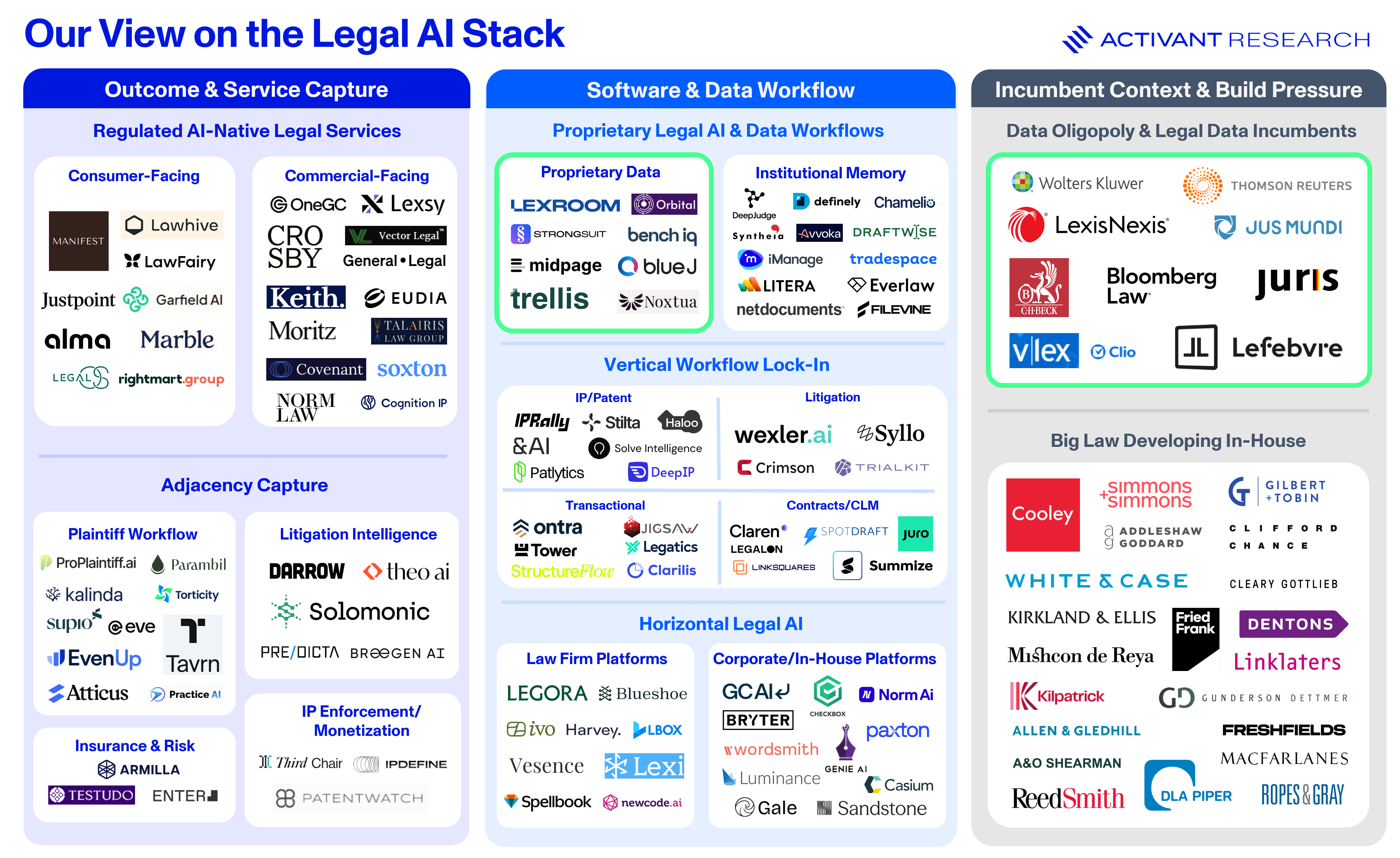
On September 23, Noxtua announced a Series C of more than €100 million, with German legal publisher C.H.BECK becoming its majority shareholder and Austrian publisher MANZ joining as an investor.1 C.H.BECK had already backed Noxtua, and their joint product launched in 2025.234 What has changed is control: the publisher now controls an application built around its content. It is also the largest investment in C.H.BECK’s more than 260-year history.
We think this sharpens the central question in legal AI. As software makes legal information easier to use, who captures the additional value: the company supplying the content or the platform through which lawyers use it? Our view is that owning the content gives publishers the advantage in legal research, but not across legal work as a whole. For independent platforms, that means keeping their bargaining power only where they control workflows that lawyers would find costly to replace.
Our earlier Legal AI research, The Moat, Not the Model, distinguished vendors that own their defensibility from those that depend on others for it. Noxtua brings that distinction into the ownership structure. In this arrangement, a publisher can participate in the application’s upside while protecting its position as a content supplier. Independent platforms, by contrast, must build enough bargaining power to retain an attractive share of the economics.
A better product could still lose on price
If lawyers consider a publisher’s commentary and reference works essential, an application needs access on terms that publisher accepts. Better software can also increase demand for the underlying material, strengthening the supplier as well as the application.
C.H.BECK’s majority ownership brings the publisher and the AI application under common control. That gives it a strong incentive to support Noxtua’s access to its content. How much of an advantage that creates, however, depends on how much lawyers value that content and how effectively Noxtua incorporates it into their work.
Control adds another potential advantage: the ability to consider content and software economics together. For example, Beck-Noxtua already sells packages combining its AI workspace with beck-online access.5 For a customer buying both, this means the decision can come down to the total research and software bill.
Consider, for example, a renewal where the publisher accepts less incremental revenue for AI to retain the content subscription. That could be attractive across the combined businesses, even if the AI product contributes little profit on its own. An independent rival, by contrast, would need to license comparable content from another publisher or build its own if it could not license beck-online on the same terms. It would then have to cover that cost and still justify an additional subscription. This is a possible competitive response, not evidence that C.H.BECK currently subsidizes Noxtua.
An independent platform could therefore face pressure even with a good product. For investors, this means examining the economics of the whole customer relationship, including how bundled revenue and content costs are allocated, before comparing application margins.
The opening for Harvey and Legora, then, is to become valuable enough that lawyers keep paying for them even when a publisher they already pay offers an alternative.
Why publishers still need platforms
The strongest counterargument is that publishers can earn more by supplying successful platforms than by trying to replace them. For example, Harvey’s June 2025 alliance with LexisNexis covered legal content, citation services, AI technology and joint workflow development.6 Legora has since announced a partnership with the American Law Institute to bring its Restatements of the Law into Legora’s research platform.7
These partnerships demonstrate a route to content access without acquiring the publisher. But their undisclosed economics do not establish how much profit the platform retains, and US partnerships do not prove that C.H.BECK’s German content is replaceable. They do, however, show why publisher ownership is only one possible structure for the market. For this argument, though, the closer test is Germany itself. Legora says that where publishers will not partner, it goes to the source directly, and that in Germany the obstacles are digitization and anonymization. That is a route around C.H.BECK, though not yet evidence that it can replace the publisher’s commentary.8
Beyond content access, an independent platform’s position becomes stronger when customers depend on it for work beyond research. For example, a firm using one application to review documents, apply its own precedents and coordinate drafting would face more disruption in replacing it than in switching a search interface. The application could then retain the customer even as individual content sources change.
That gives the publisher a reason to participate: the platform brings demand and distribution that the publisher would otherwise have to win itself. For the platform, licensing valuable content can support an attractive business if the application also supplies something scarce. The key, then, is whether it controls a workflow customers depend on or merely provides another way to query someone else’s database.
The bundling advantage therefore has a limit. Buyers may keep paying for a separate platform if its broader capabilities save enough work to justify the additional cost. After all, owning content does not establish that a publisher will build the application customers prefer.
That makes renewal a revealing moment: does the firm still want both products, and can the platform make money after paying for its content?
The real test comes at renewal
Noxtua’s financing makes publisher control a concrete competitive model. Earlier investors, including the law firms CMS and Dentons, sold their stakes in the round while remaining customers.9 However, the financing does not tell us what returns those investors earned, or how future profit will be divided between the publishing and software businesses.
We would therefore focus diligence on three things: the durability of content rights, control of the customer relationship and the margin remaining after content and delivery costs. A partnership announcement, on its own, answers only part of the first question.
This question of who retains the savings also explains our interest in AI-native law firms, which we highlighted in our research The Moat, Not the Model. Firms such as Crosby and Manifest Law, powered by Manifest OS, seek to capture more of the economics of delivering legal services. On fixed-fee work, lower delivery costs can improve margins without reducing the client’s bill. If competition between publishers and software platforms makes capable legal AI cheaper, these firms could capture part of the benefit. The investment question therefore extends beyond who supplies the content or software to who retains the savings when the work gets cheaper.
Returning to independent software platforms, the test over the next twelve months is whether they retain and expand paid customer relationships at attractive margins after content costs, despite competing publisher bundles. If they do, control of the workflow may provide as much bargaining power as ownership of the content. If customers consolidate spending with publishers, the advantage will lie increasingly with those able to price both together.
The clearest evidence will be a customer choosing to renew an independent platform after its publisher has put a credible alternative on the table.
Footnotes
-
Noxtua, C.H.BECK invests 100M+ EURO in their partnership with Noxtua, 2026 ↩
-
Noxtua, Noxtua raises € 80.7 Million for Europe’s sovereign Legal AI, 2025 ↩
-
Noxtua, Legal work reimagined, 2025 ↩
-
Noxtua, Launch von Beck-Noxtua, 2025 ↩
-
Beck-Noxtua, Ihr Start mit Beck-Noxtua, 2026 ↩
-
LexisNexis, LexisNexis and Harvey Announce Strategic Alliance to Integrate Trusted, High-Quality AI Technology and Legal Content and Develop Advanced Workflows, 2025 ↩
-
Legora, Legora Partners with The American Law Institute to bring Restatements of the Law into their legal research platform, 2026 ↩
-
Legora, Legora rebuilds legal research with comprehensive data, a full ontology of law, and an AI-native citator, 2026 ↩
-
The Legal Wire, C.H.BECK invests over €100M in Noxtua as MANZ joins Series C, 2026 ↩
Disclaimer: The information contained herein is provided for informational purposes only and should not be construed as investment advice. The opinions, views, forecasts, performance, estimates, etc. expressed herein are subject to change without notice. Certain statements contained herein reflect the subjective views and opinions of Activant. Past performance is not indicative of future results. No representation is made that any investment will or is likely to achieve its objectives. All investments involve risk and may result in loss. This newsletter does not constitute an offer to sell or a solicitation of an offer to buy any security. Activant does not provide tax or legal advice and you are encouraged to seek the advice of a tax or legal professional regarding your individual circumstances.
This content may not under any circumstances be relied upon when making a decision to invest in any fund or investment, including those managed by Activant. Certain information contained in here has been obtained from third-party sources, including from portfolio companies of funds managed by Activant. While taken from sources believed to be reliable, Activant has not independently verified such information and makes no representations about the current or enduring accuracy of the information or its appropriateness for a given situation.
Activant does not solicit or make its services available to the public. The content provided herein may include information regarding past and/or present portfolio companies or investments managed by Activant, its affiliates and/or personnel. References to specific companies are for illustrative purposes only and do not necessarily reflect Activant investments. It should not be assumed that investments made in the future will have similar characteristics. Please see "full list of investments" at activantcapital.com/companies/ for a full list of investments. Any portfolio companies discussed herein should not be assumed to have been profitable. Certain information herein constitutes "forward-looking statements." All forward-looking statements represent only the intent and belief of Activant as of the date such statements were made. None of Activant or any of its affiliates (i) assumes any responsibility for the accuracy and completeness of any forward-looking statements or (ii) undertakes any obligation to disseminate any updates or revisions to any forward-looking statement contained herein to reflect any change in their expectation with regard thereto or any change in events, conditions or circumstances on which any such statement is based. Due to various risks and uncertainties, actual events or results may differ materially from those reflected or contemplated in such forward-looking statements.