AI · Agentic Procurement · Commerce — September 3, 2026
Agentic Procurement
The First Agent-to-Agent Market
Fifteen trillion dollars. That is the business-to-business (B2B) spend Gartner expects AI agents to sit in the middle of by 2028, steering 90% of business buying through what it calls AI agent exchanges.1 Only two economies, the United States and China, have an annual GDP larger than that.2 Yet most of the media hype centers on the consumer. We believe that gets the order backwards: the first market where software buys from software at scale will be procurement, the unglamorous business of how companies purchase what they run on, and it is further along than most investors realize.
Consider what already operates inside Walmart’s supply chain. For several years, Pactum’s software has negotiated with the retailer’s suppliers directly. Not paperwork, not invoice matching, but the negotiation itself: it proposes terms, weighs the counteroffer, trades a price concession for a better payment schedule, and closes. Walmart pointed it at thousands of suppliers at once, a volume no human team could staff, reached agreement with 68% of them, and stretched payment terms by an average of 35 days.3
The public conversation about AI that buys things is consumer-first, and for a while ours was too. We wrote a three-part series on agentic commerce, the glamorous end of the market, where an assistant books your travel and fills your cart. But the evidence kept pointing elsewhere. Every obstacle we mapped on the consumer side – access, identity, payment, trust – turned out to be a problem enterprise had already solved for human buyers. That realization led us back to procurement, where our 2025 research had argued that AI inside the function was becoming table stakes rather than an edge. This piece closes the loop and explains the frameworks it borrows as it goes.
Gartner’s 2028 timeline may prove aggressive. The direction is harder to dismiss. And it points away from shopping apps and toward the plumbing of trade between companies. The argument runs in three moves.
- The enterprise already owns the infrastructure an autonomous purchase requires. Consumers are still waiting for theirs to be built.
- The bigger disruption is on the sell side. Once both parties field agents, much of B2B selling as currently practiced stops making sense.
- Buyers will adopt agents. The open question is which suppliers resist, and that answer splits on how replaceable the supplier is.
The Enterprise Already Has the Plumbing
The framework we built in our commerce series carries over cleanly. Agentic commerce rests on three layers: applications where intent becomes action, an enablement layer that lets an agent actually transact, and shared model infrastructure underneath. Agents earn their keep in both worlds the same way, by taking over purchases nobody enjoys. Batteries and printer ink for a household; tail spend and software renewals for a company. Where the buying is the pleasure, the agent stays an assistant.
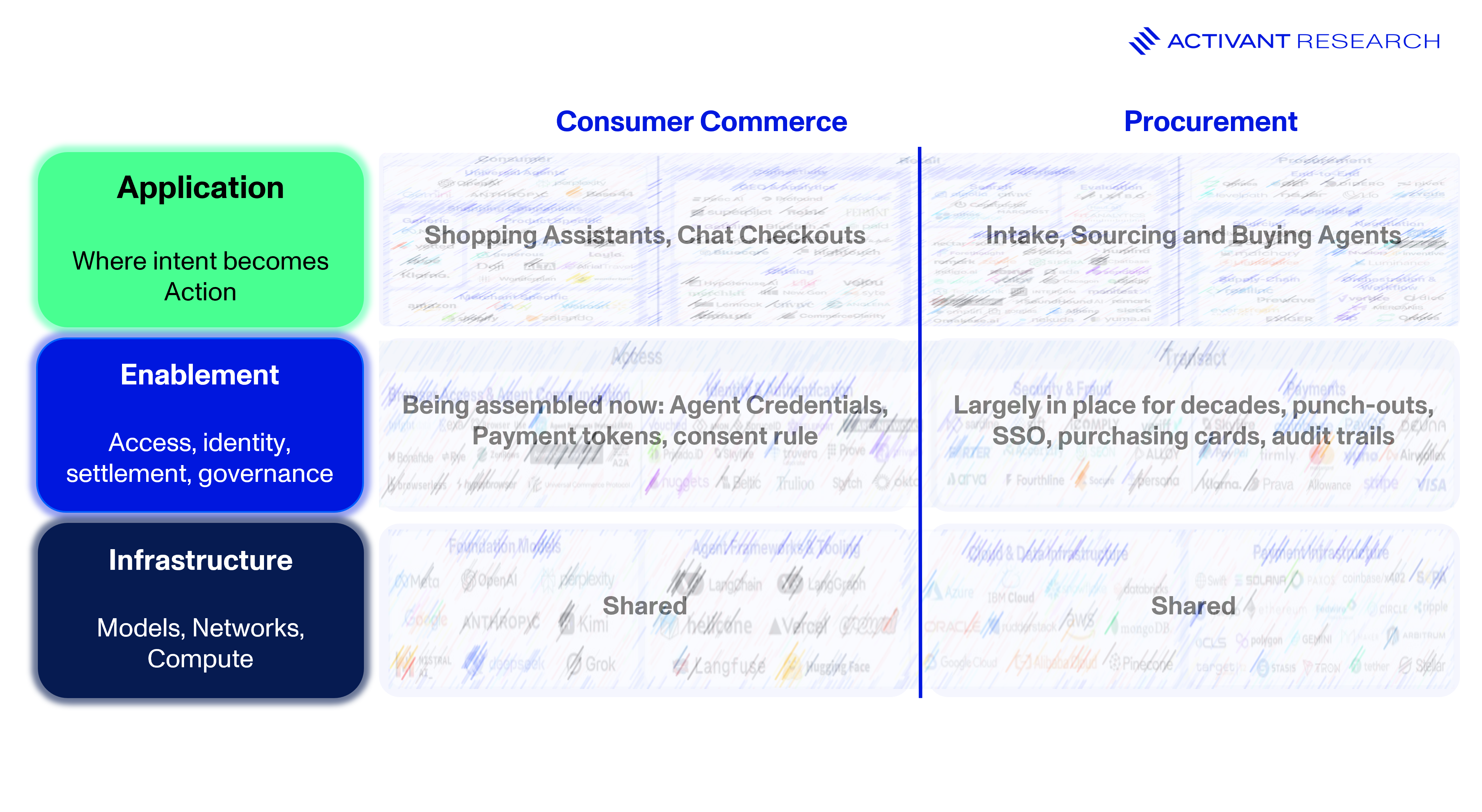
For the full agentic commerce market map, see the three-part series on agentic commerce.
Four Problems, Three Already Solved
The middle layer is where the two markets stop resembling each other. In the second agentic commerce piece, Who Gets to Transact, we argued that any autonomous purchase has to solve 4 problems before it can happen: access to the seller, identity that proves the agent acts for a real buyer with authority to spend, settlement that moves money within limits, and governance that says who is accountable when something goes wrong. Consumer commerce is building all four right now, largely from scratch. OpenAI and Stripe open-sourced the Agentic Commerce Protocol in September 2025 so that a chatbot could complete a checkout.4 Google answered with its Agent Payments Protocol, Visa and Mastercard are tokenizing agent credentials, and the x402 protocol revived the web’s dormant 402 “payment required” status code as a stablecoin rail for machines.5 Watch what shape those payment tokens take. A credential with hard spending limits, tied to a policy, reconciled after the fact. Companies have a name for that.
The model now being invented for consumer agent payments is a corporate expense card, arriving four decades late. And the pattern holds across the layer. Enterprises have bought programmatically through electronic data interchange (EDI) and punch-out catalogs since the 1990s; the consumer equivalent shipped last year. Single sign-on and delegated approval matrices answer the identity question that consumer agents are only now confronting. Purchasing cards, accounts payable, and three-way match answer settlement. Of the four problems, three are solved infrastructure inside the enterprise and open construction sites outside it.
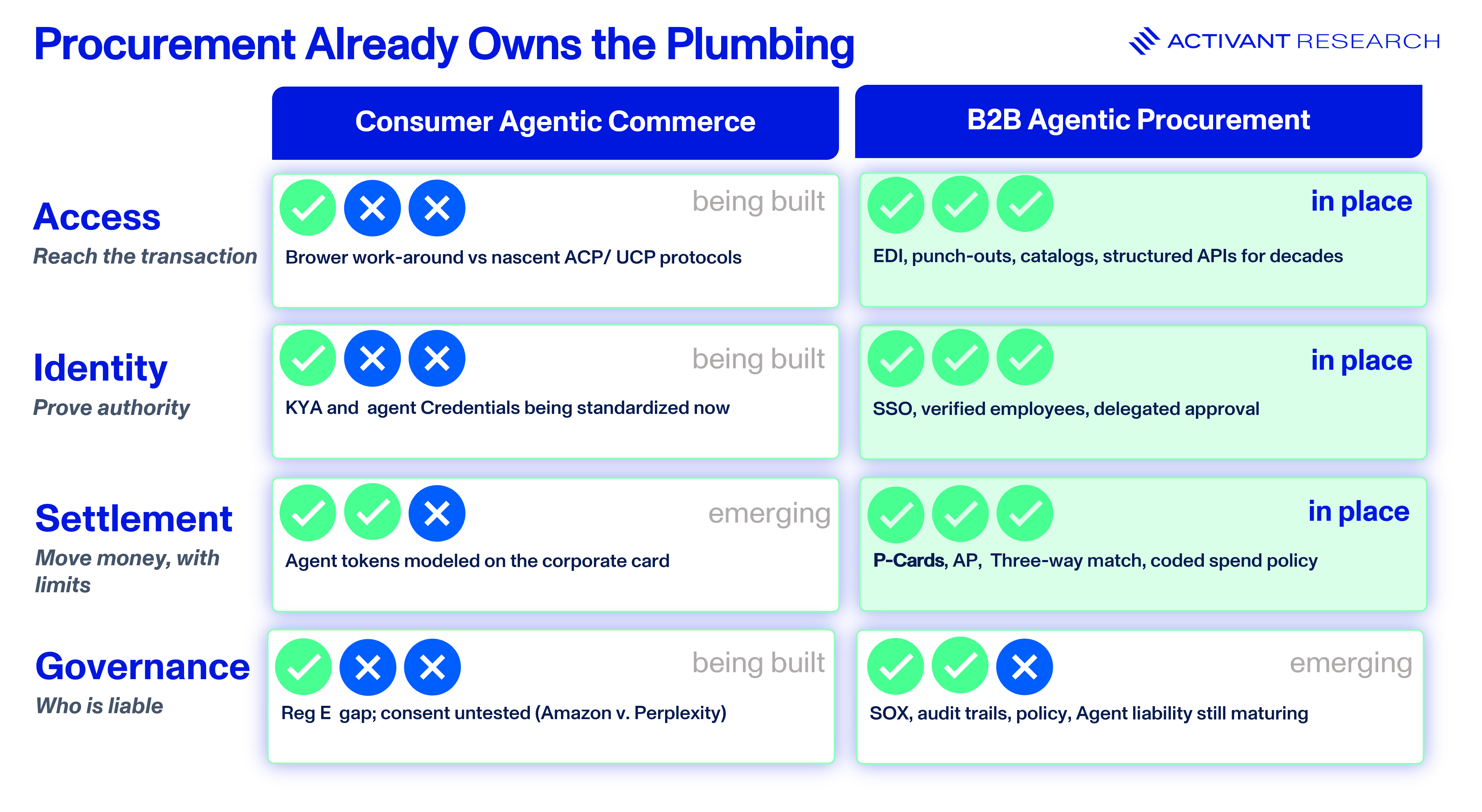
3 of the 4 requirements for an autonomous purchase already exist inside the enterprise. Governance is the shared gap.
The Governance Gap Is a Market
Governance is the shared gap, and it is real. US consumer protections for disputed electronic payments were written for humans, and nobody has settled what counts as an agent’s valid consent.6 The insurance market has now voted on the question: in November 2025, AIG, Great American, and WR Berkley asked US regulators for permission to exclude liabilities tied to AI agents and chatbots from standard corporate policies.7 When the people paid to price risk decline to price one, liability for autonomous transactions is unallocated. Unallocated is not the same as unpriceable, though. AIUC, launched in mid-2025 with a $15 million seed, certifies agents against its AIUC-1 standard, an emerging SOC-2 for agents, and ties liability cover of up to $50 million to the audit results.8 When the incumbents exclude a risk and a seed-stage underwriter builds a business pricing it, the gap is a market. Even here, the enterprise starts ahead. Audit trails, spend controls, and financial compliance regimes exist; they need extending to agents, not inventing.
This is also why the trust problem that dominates the consumer debate barely slows a company down. Bain found that 72% of US consumers had used AI, 24% were comfortable letting it buy something, and 10% had actually done so.9 That gap between trying and trusting is the single biggest brake on consumer agentic commerce. What a shopper must grant one nervous purchase at a time, the enterprise wrote into policy decades ago. The rails that Activant portfolio companies Sardine and Deuna are respectively building for fraud and identity; and agent-ready checkout and payments recreate the controls a company already keeps behind its firewall for strangers. Procurement is not waiting on that construction, which is precisely why it moves first.
No Joy in a Purchase Order
Plumbing sets who can move first. Experience sets how far they get. The e-commerce lesson from the commerce series transfers: online retail never replaced the store; it expanded only to the degree the experience survived a screen. US e-commerce runs at about 17% of retail overall, yet more than half of consumer electronics sells online while groceries and cars sit under 10%.10 Agents will trace the same uneven curve. Procurement sits at the deepest end of that curve because most enterprise spend is low-experience by design. There is no showroom to protect and no joy in raising a purchase order.
That inverts the ceiling. Consumer agents are capped by how much buying is emotional; procurement agents are capped only by how much buying requires judgment. We estimate the near-term agent-eligible share of enterprise spend at roughly a third to a half: the long tail of small purchases, routine indirect categories, and recurring software.11 The tail is 80-90% of a company’s suppliers but only around 20% of its money.12 High volume, small tickets, rule-based decisions. Strategic and direct categories, where a wrong call is expensive and the relationship is real, will stay with people for years.
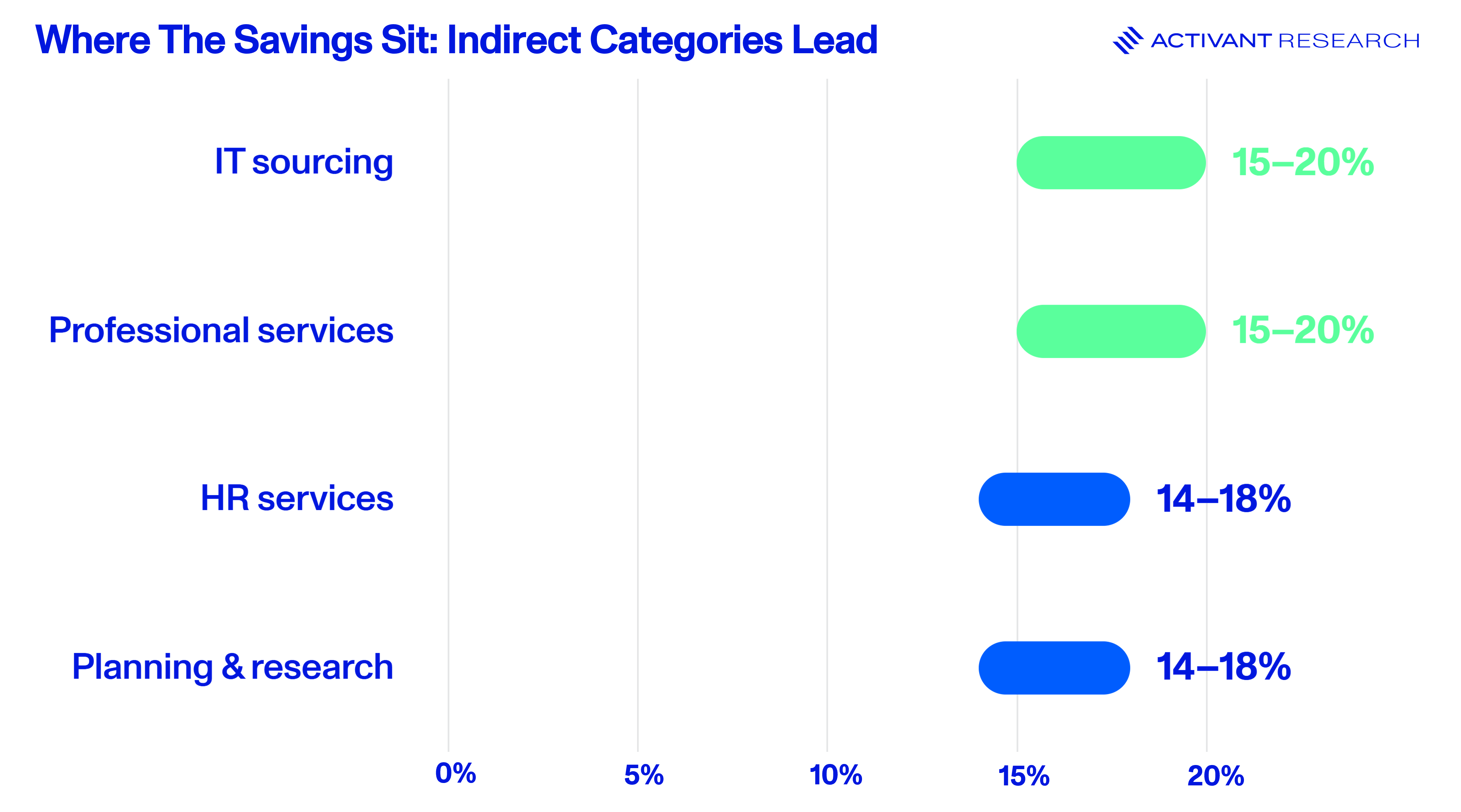
Achievable savings by indirect category. The agent-eligible tail is where the volume sits.
Who Is Already Collecting
The prize in that tail is well documented. The consultancy Roland Berger puts achievable tail-spend savings at 15-20% in IT and professional services and 14-18% in HR.12 Price is only half of it. World Commerce & Contracting, working with Ironclad, found procurement contracts leak 11% of their value after signature, through missed obligations, unfavorable renewals, and terms nobody enforces.13 An agent that never forgets a renewal date polices exactly that leak. Vertice holds pricing benchmarks on more than 16,000 software vendors, so a renewal that once happened in the dark now happens against data.14 Specialists such as Fairmarkit and Keelvar built their businesses automating exactly this lane, the sourcing events too small for a human buyer to run. A younger cohort is going straight after full autonomy: Procure AI runs spot-buys and tactical sourcing events end to end and reports 3.7-5.2% savings per event.15 Most telling is Cavela, whose seed-stage agents source and negotiate with factories across 40-plus countries for consumer brands, the frontier already creeping from indirect spend into small-scale direct sourcing.16
The largest wedge, though, is not a procurement company at all. Ramp built its business on the corporate card, the very artifact consumer rails are now reinventing, and in April 2026 extended it into a fleet of procurement agents that triage requests, source vendors, and review contract terms, priced against benchmarks drawn from the more than $100 billion of purchasing it processes each year.17 The pitch underneath is this piece’s thesis in miniature: procurement-grade rigor for the 98% of US companies that never had a procurement team.
The labor case is quantified too. Bain projects that by 2027, the tasks filling a typical 9-hour procurement day will compress to under an hour of manual effort as agents absorb vendor research, contract analysis, categorization, and approvals.18 Tail spend goes first. Strategic sourcing goes last, if it goes at all.
The Seller Fields an Agent Too
Everything above is the buy side, and the buy side is where most analysis stops: hand the procurement team back its 9 hours. Read the Gartner forecast again, though, and notice the wording. It does not say agents will help buyers. It says 90% of B2B buying will be intermediated by agents, pushed through AI agent exchanges. Sellers have to field agents for that sentence to come true. Forrester expects exactly this, and soon: during 2026, one in five B2B sellers will be pushed into agent-led quote negotiations, answering AI buyer agents with counteroffers delivered by seller-side agents of their own.19
Machines already trade with machines in equities and advertising, as we noted in the commerce work, but those are price-only auctions over interchangeable units. Procurement is where the exchange becomes negotiation across price, payment terms, delivery, service levels, and compliance at once, because written policy and total-cost math give a machine the objective function that consumer taste never could. In logistics you can already hear it: HappyRobot’s voice agents negotiate freight rates over the phone for DHL, Ryder, and more than 70 enterprise logistics customers, machine negotiation running down a channel built for human voices.20 The tooling for both chairs is shipping now. Microsoft’s first batch of autonomous Dynamics 365 agents, launched in October 2024, included a Supplier Communications Agent for the buyer and a Sales Order Agent for the seller, both sides of the counter in one release.21 Luminance, the legal AI company, ships Lumi Go, which auto-negotiates contract terms with a counterparty and is expanding into procurement.22 Arkestro, an Activant company, builds the predictive engine underneath buyer-side negotiation. Pactum, meanwhile, is in production at Walmart scale.3
Go-to-Market Gets Repriced
When both parties run agents, negotiation collapses into an exchange of machine-readable offers, and much of what B2B selling has always consisted of collapses with it. The asset being repriced is B2B go-to-market itself: the account reps, the request-for-proposal (RFP) cycle, and the quiet gap between list price and the price a skilled negotiator gets. Industry estimates put 2.5-3 million people in B2B sales in the United States alone.23 That payroll likely runs into hundreds of billions of dollars annually.24 That, not the software line, is the denominator that matters, and the most underbuilt product in B2B software today is the seller’s agent that will defend it. The current shelf is retrofitted: configure-price-quote (CPQ) vendors bolting recommendation engines onto quoting, pricing incumbents adding agents at the edge. The closest thing to a true seller’s agent grew out of the support channel. Sierra, Bret Taylor’s agent company, reportedly reached $150 million of run-rate revenue in eight quarters, and its agents already take payments and process renewals inside customer conversations.25 Sierra shows enterprises will let software represent them commercially. What remains missing is the negotiation itself, the agent that answers a buyer’s agent with a counteroffer. That absence is the opportunity.
Suppliers Will Split, Not Surrender
A buyer’s agent that enforces comparison and total cost is an attack on supplier margin, because much of that margin is manufactured by the frictions the agent removes. Price opacity lets one part sell at very different prices to different accounts. Maverick spend is the buyer who never shopped around. Auto-renewal is the contract nobody reopened. Strip those away and the arithmetic moves fast: Kearney, the consultancy, estimates distributors could shed up to 5 percentage points of EBIT margin as agents force pricing into the open,26 and the pricing firm Simon-Kucher, studying wholesale segments already exposed to agentic buying, reports gross margins pushed below 5% and concludes that profit models built on opacity are no longer viable.27
The standard advice to suppliers is to adapt. Almost nobody models the other response, refusal, even though the consumer market has already staged both endings in public. Amazon sent Perplexity a cease-and-desist in late 2025 and then sued, arguing that an agent shopping while logged in as a user strips out the browsing, recommendations, and impulse buys its storefront is built to produce; a federal judge granted Amazon a preliminary injunction in March 2026.28 That same October, Walmart did the opposite and opened its storefront to ChatGPT.29 One retailer sued the agent out; the other invited it in. And refusal now has industrial-grade infrastructure. Since July 2025, Cloudflare, whose network carries about a fifth of web traffic, blocks AI crawlers by default and offers a Pay Per Crawl toll booth, meaning any supplier can block or meter an agent with a setting rather than a lawsuit.30 We expect the B2B versions to be quieter and sharper: muddied catalogs, withheld pricing APIs, most-favored-nation, and anti-agent clauses in the terms. A seller’s agent can decline to quote a buyer’s agent, and the deal dies in a protocol handshake instead of a conversation.
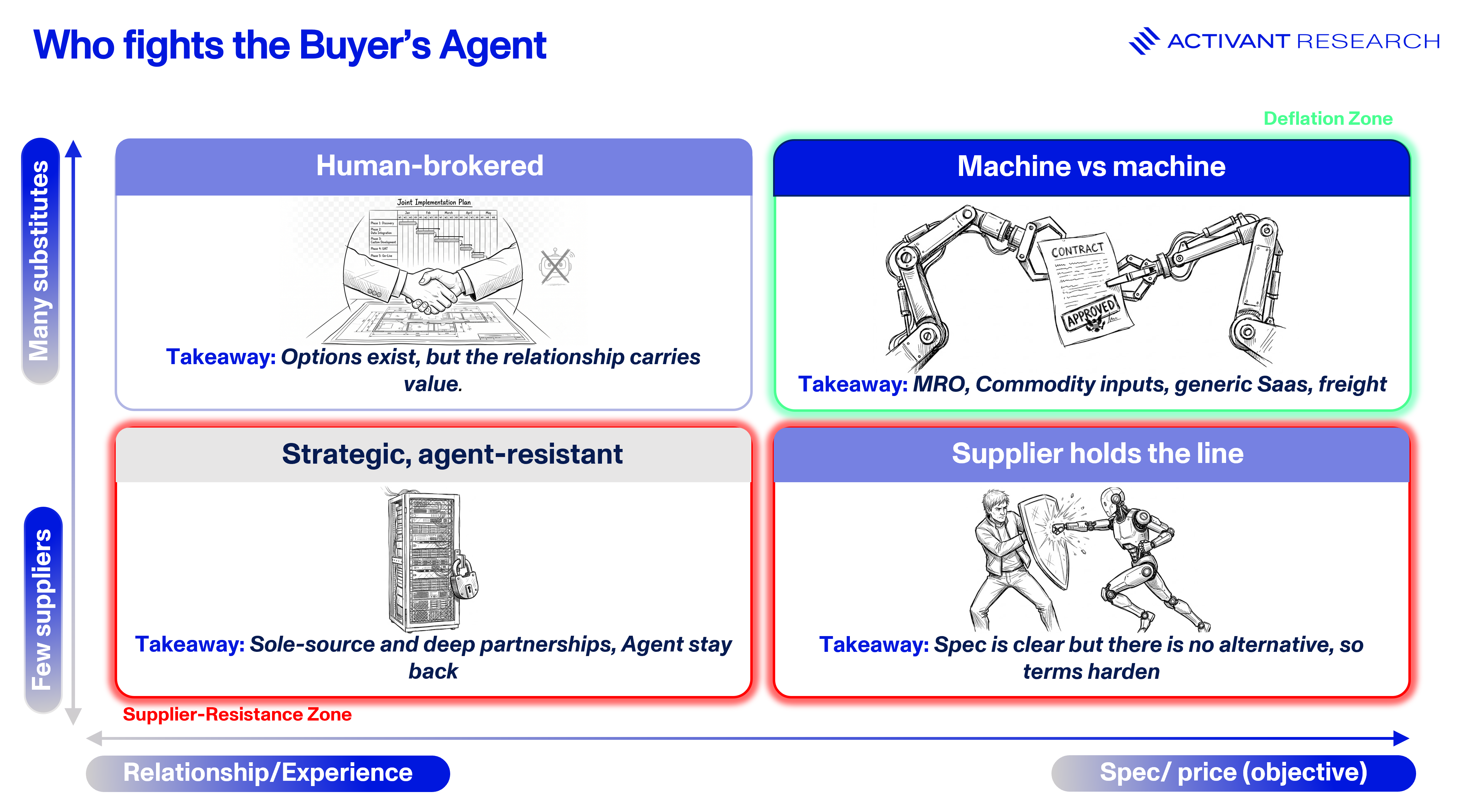
Where suppliers can be swapped, agents arbitrage price. Where they cannot, terms harden.
Which suppliers fight and which fold is not random. It turns on two questions: how substitutable the supplier is, and how objective the purchase is. Interchangeable suppliers selling to a specification – in maintenance, repair, and operations (MRO) supplies, commodity inputs, generic software, and freight – face the deflation zone; the buyer’s agent holds the leverage and margin compresses toward cost. Many will not even resist: roughly 75% of Walmart’s suppliers preferred negotiating with the agent over a human.31 Concentrated or sole-source suppliers with real lock-in, patented components and licensed platforms among them, hold the line and harden terms, exactly as Amazon did. Walmart could open its storefront because retail is substitutable; Amazon could shut its doors because a marketplace with roughly 40% of US e-commerce is not. Supplier substitutability, not buyer readiness, sets the pace of this market.
The System of Record Fights Back
Step back and this is a pattern we have tracked across enterprise software: the migration from systems of record to systems of intelligence. For decades, value pooled in the database that stored what happened, wrapped in workflow. In procurement those were the enterprise resource planning (ERP) suites and purchasing platforms that digitized the paper trail while the actual substance of a buying decision – the emails, the contracts, the supplier calls – stayed invisible to them. A system of intelligence reads that unstructured reality and acts on it. Agentic procurement is a system of intelligence with a purchase order at the end.
Price the Work, Not the License
The economics change with the denominator. Software that replaces work gets priced against the work, not against the old license line. Visible procurement software is a roughly $8 billion market globally today, heading for about $17 billion by 2032.32 Set that against the payroll it touches, remembering that procurement is often a company’s second-largest expense after payroll itself,33 and against the $15 trillion of global spend the software governs. The sales-payroll bar in that chart is US-only, which makes it the conservative reading. $17 billion is the floor. The spend the software governs, plus the selling and buying labor stacked on both sides of it, is the ceiling.
The incumbents can read that chart too. SAP has embedded its Joule agents across Ariba and in May 2026 unveiled an Autonomous Suite orchestrating more than 200 specialized agents.34 Oracle embedded procurement agents across Fusion at no additional cost, which is bundling with intent.35 Coupa now markets itself as the autonomous spend platform, and this spring it bought Tonkean, one of the leading independent orchestration players, along with the document AI company Rossum.36 Read that acquisition carefully. The system of record did not out-build the control layer. It purchased a piece of it.
The Control Layer
Capital is crowding into the challengers all the same. Zip raised $190 million at a reported $2.2 billion valuation in October 2024, the largest procurement-technology round in over 2 decades, with $107 billion of spend already processed through its intake and orchestration platform.33 Levelpath and Omnea each closed $50 million-plus Series Bs in 2025.,3738
So where does durable value settle? Our answer is narrower than the market’s. It belongs to whoever owns the two things an autonomous transaction cannot proceed without: the agent’s verified identity and the audit-and-liability record of what it did. That is the control layer.
The primitives are being built at seed stage right now. Catena Labs, founded by Circle co-founder Sean Neville, is building what it calls an AI-native financial institution: cryptographic identity that chains an agent back to the legal entity it spends for, wallets with programmable limits, and the audit trail underneath.39 Skyfire is standardizing the same idea as Know Your Agent, know-your-customer (KYC) checks rewritten for software.40 Both aim at the open market first, but the credential they are standardizing is exactly the one a procurement agent will present. Security buyers reached the same conclusion before the software market did: Cisco paid roughly $400 million this year for Astrix, whose product governs machine credentials, the API keys, service accounts, and now agents, inside the enterprise.41 The control layer is also the layer the suites are now buying and bundling their way back into, which tells you how the bet fails. The control layer is a business only while it remains the system of record’s master rather than its feature.
Who Is Building?
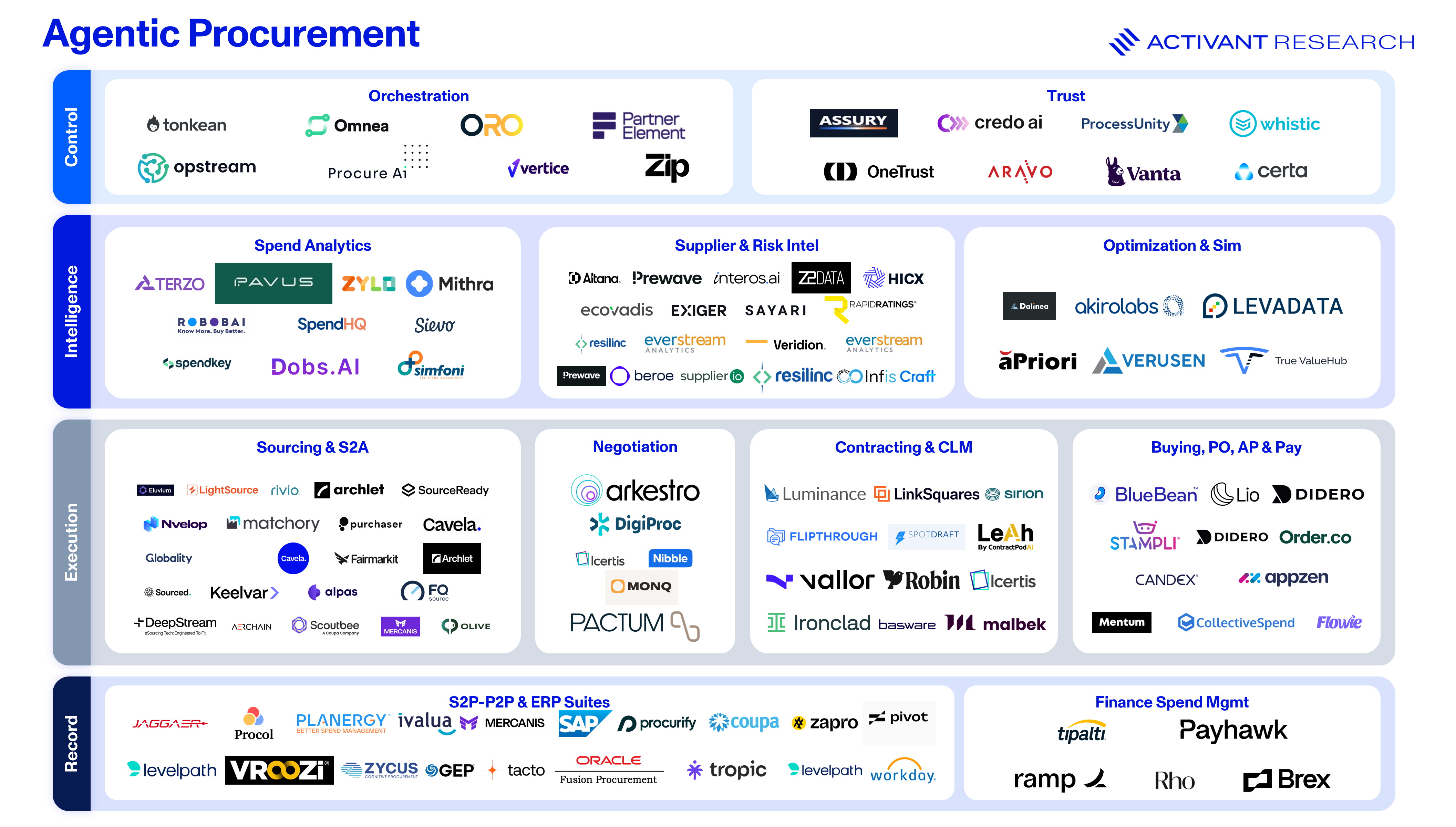
The market map below is the thesis drawn as a picture, and it reads bottom to top. The record layer is incumbent territory, and it is where Coupa just went shopping. The execution lanes above it are the most crowded because sourcing events, negotiations, and payments are where agents prove savings fastest, and crowded lanes compress. The intelligence layer feeds them all. The thin shelf at the top – orchestration and trust – is the control layer, and its scarcity is the point. Whoever holds identity and audit decides whether everything beneath is allowed to transact.
Who is building, layer by layer. The crowded lanes are not where the durable value settles.
Where We Come Out
The technology will keep moving fast. The bones of procurement hold. Category management, source-to-contract, procure-to-pay, and procurement excellence remain the load-bearing blocks, and even the most autonomous platforms still organize around them.42 What changes is where the hours go, from executing steps to writing playbooks and working exceptions. And governance does not merely survive the transition. It intensifies, because the incumbent insurers just made every company self-insured for its agents’ mistakes.7
For investors, we would underwrite three things. First, the control layer: identity, audit, and orchestration, but only where that layer can stay independent of the suites now bundling and acquiring their way into it. Second, the seller’s agent, which we consider the most underbuilt product in B2B software given that one in five sellers meets a buying agent this year.19 Third, the evaluation and data-quality tooling both sides depend on: Braintrust already gates AI releases at Stripe, Notion, and Vercel; LangChain’s LangSmith is the default trace layer for agent stacks; and Patronus AI built the safety evaluators that regulated buyers will demand.43
We would treat legacy sell-side go-to-market, still priced as if human reps and opaque quotes persist indefinitely, as the short side of the trade. The clock, meanwhile, is not set by model quality. Liability that incumbent insurers refuse to price, and suppliers concentrated enough to wall agents out: those two frictions, not the technology, will decide how fast $15 trillion changes hands.
The first true agent-to-agent market will not be a shopper buying shoes. It will be one company’s software buying from another company’s software, inside procurement, on rails that mostly exist today. The open question is no longer whether that happens. The open question is who owns the handshake.
Footnotes
-
Gartner, Top Predictions for IT Organizations and Users in 2026 and Beyond, October 2025. ↩
-
International Monetary Fund, World Economic Outlook, April 2026 vintage (nominal GDP). ↩
-
Pactum, Enterprise Client Success with Agentic AI in Procurement, 2026. ↩ ↩2
-
OpenAI, Buy It in ChatGPT: Instant Checkout and the Agentic Commerce Protocol, September 2025. ↩
-
Google Cloud, Announcing the Agent Payments Protocol (AP2), September 2025. ↩
-
Center for Data Innovation, Agentic Commerce Is Coming, but Regulation Meant for Humans Will Slow It Down, March 2026. ↩
-
PYMNTS, Insurers Uneasy About Covering Corporate AI Risks, November 2025. ↩ ↩2
-
Fortune, AIUC, a Startup Creating Insurance for AI Agents, Emerges from Stealth with $15 Million Seed, July 2025. ↩
-
Bain & Company, Agentic AI Commerce Hinges on Consumer Trust, July 2025. ↩
-
U.S. Census Bureau, Quarterly Retail E-Commerce Sales, 2026 ↩
-
Activant analysis, 2026. Build-up: tail spend at roughly 20% of spend value plus routine indirect categories and recurring software renewals; the range reflects category mix, which varies widely by industry. ↩
-
Roland Berger, Unlocking the Hidden Value in Tail Spend, 2026. ↩ ↩2
-
World Commerce & Contracting, Closing the Procurement Value Gap, January 2026. ↩
-
PR Newswire, Vertice Raises $50 Million Series C to Simplify Procurement, January 2025. ↩
-
Procure AI, Seed Funding Announcement, November 2025. ↩
-
TechCrunch, Cavela Lands $6.6M to Help Brands Beat Pre-Tariff Manufacturing Costs, November 2025. ↩
-
Ramp, Ramp Launches Fleet of AI Agents Across Its Procurement Platform, April 2026. ↩
-
Bain & Company, Ready, Set, Go: AI Is Poised to Automate Procurement, September 2024. ↩
-
Forrester, 2026 B2B Marketing, Sales, and Product Predictions, October 2025. ↩ ↩2
-
HappyRobot, Series B Announcement, September 2025. ↩
-
Microsoft, Transform Work with Autonomous Agents Across Your Business Processes, October 2024. ↩
-
Luminance, Series C Announcement, February 2025. ↩
-
Zippia, 28 Vital B2B Statistics, 2026 ↩
-
Activant analysis, 2026: 2.5-3 million US B2B sellers (see prior note) at average all-in compensation of $100,000-130,000 implies roughly $250-390 billion of annual payroll. ↩
-
CNBC, Bret Taylor’s Sierra Raises Nearly $1B in Latest AI Capital Push, May 2026 ↩
-
Distribution Strategy Group, AI Agents Are Reshaping B2B Buying, October 2025 ↩
-
Simon-Kucher, Agentic AI in B2B: A Game-Changer for Wholesale Pricing, September 2025. ↩
-
CNBC, Amazon Wins Court Order to Block Perplexity’s AI Shopping Agent, March 2026 ↩
-
Walmart, Walmart Partners with OpenAI to Create AI-First Shopping Experiences, October 2025. ↩
-
Cloudflare, Cloudflare Just Changed How AI Crawlers Scrape the Internet-at-Large, July 2025. ↩
-
PYMNTS, Walmart Reportedly Finds 75% of Vendors Prefer Negotiating With Chatbot, April 2023. ↩
-
GlobeNewswire, Procurement Software Market Forecast Report, 2024-2032, December 2024. ↩
-
Business Wire, Zip Secures $190 Million in Landmark Series D Funding, October 2024. ↩ ↩2
-
SAP, SAP Unveils the Autonomous Enterprise, May 2026. ↩
-
Oracle, Oracle Advances Enterprise AI with New Agents Across Fusion Applications, October 2025. ↩
-
Coupa, Coupa’s Agentic Momentum Fuels Results in Q1 FY27, June 2026. ↩
-
Levelpath, Series B Announcement, June 2025. ↩
-
PR Newswire, Omnea Raises $50M to Make Procurement Every CFO’s Competitive Advantage, September 2025. ↩
-
PYMNTS, Catena Labs Raises $18 Million to Build AI-Native Financial Institution for Agents, May 2025. ↩
-
Skyfire, Know Your Agent Documentation, 2026. ↩
-
Ctech, Cisco Acquires AI Security Startup Astrix for $400 Million, 2026. ↩
-
Oliver Wyman, How Agentic AI Can Transform Procurement, 2026. ↩
-
Braintrust, Customer Disclosures, 2026 ↩
Disclaimer: The information contained herein is provided for informational purposes only and should not be construed as investment advice. The opinions, views, forecasts, performance, estimates, etc. expressed herein are subject to change without notice. Certain statements contained herein reflect the subjective views and opinions of Activant. Past performance is not indicative of future results. No representation is made that any investment will or is likely to achieve its objectives. All investments involve risk and may result in loss. This newsletter does not constitute an offer to sell or a solicitation of an offer to buy any security. Activant does not provide tax or legal advice and you are encouraged to seek the advice of a tax or legal professional regarding your individual circumstances.
This content may not under any circumstances be relied upon when making a decision to invest in any fund or investment, including those managed by Activant. Certain information contained in here has been obtained from third-party sources, including from portfolio companies of funds managed by Activant. While taken from sources believed to be reliable, Activant has not independently verified such information and makes no representations about the current or enduring accuracy of the information or its appropriateness for a given situation.
Activant does not solicit or make its services available to the public. The content provided herein may include information regarding past and/or present portfolio companies or investments managed by Activant, its affiliates and/or personnel. References to specific companies are for illustrative purposes only and do not necessarily reflect Activant investments. It should not be assumed that investments made in the future will have similar characteristics. Please see "full list of investments" at activantcapital.com/companies/ for a full list of investments. Any portfolio companies discussed herein should not be assumed to have been profitable. Certain information herein constitutes "forward-looking statements." All forward-looking statements represent only the intent and belief of Activant as of the date such statements were made. None of Activant or any of its affiliates (i) assumes any responsibility for the accuracy and completeness of any forward-looking statements or (ii) undertakes any obligation to disseminate any updates or revisions to any forward-looking statement contained herein to reflect any change in their expectation with regard thereto or any change in events, conditions or circumstances on which any such statement is based. Due to various risks and uncertainties, actual events or results may differ materially from those reflected or contemplated in such forward-looking statements.