AI · Data — November 17, 2026
Off the Record
What Salesforce's Cresta deal reveals about voice as a data layer
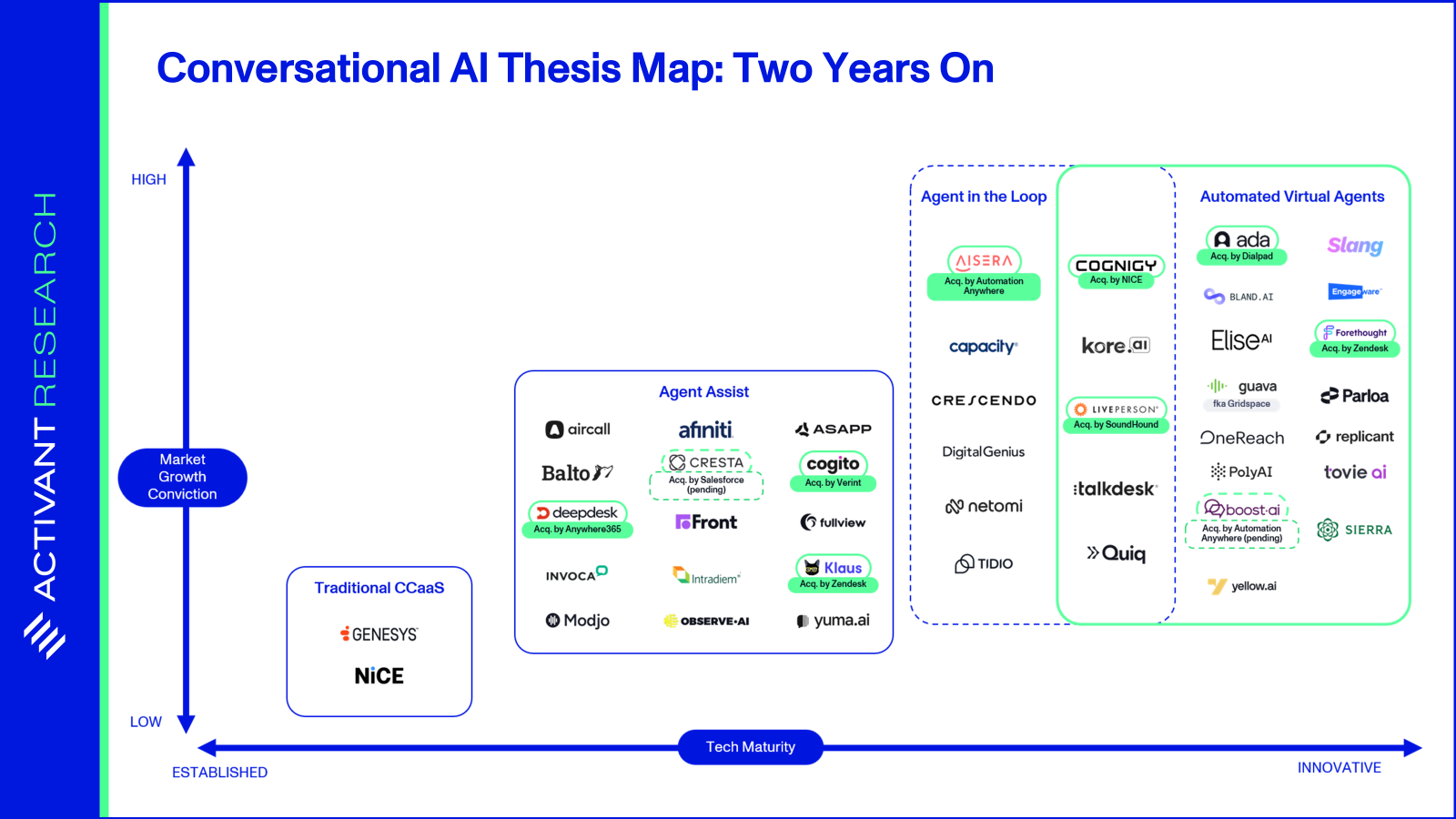
On November 2nd, Salesforce announced its agreement to acquire Cresta, bringing voice agents, real-time assistance and conversational intelligence into Service Cloud.1 Salesforce’s stated ambition is to connect the customer, the conversation and the outcome.
This year alone, we’ve seen many enterprise software incumbents move towards consolidating their conversational AI capabilities from Zendesk/Forethought, Automation Anywhere/Boost.ai, and Dialpad/Ada.234 In fact, nearly a quarter of the companies on our 2024 Voice AI customer service thesis map have since been acquired or are in the process of being acquired.
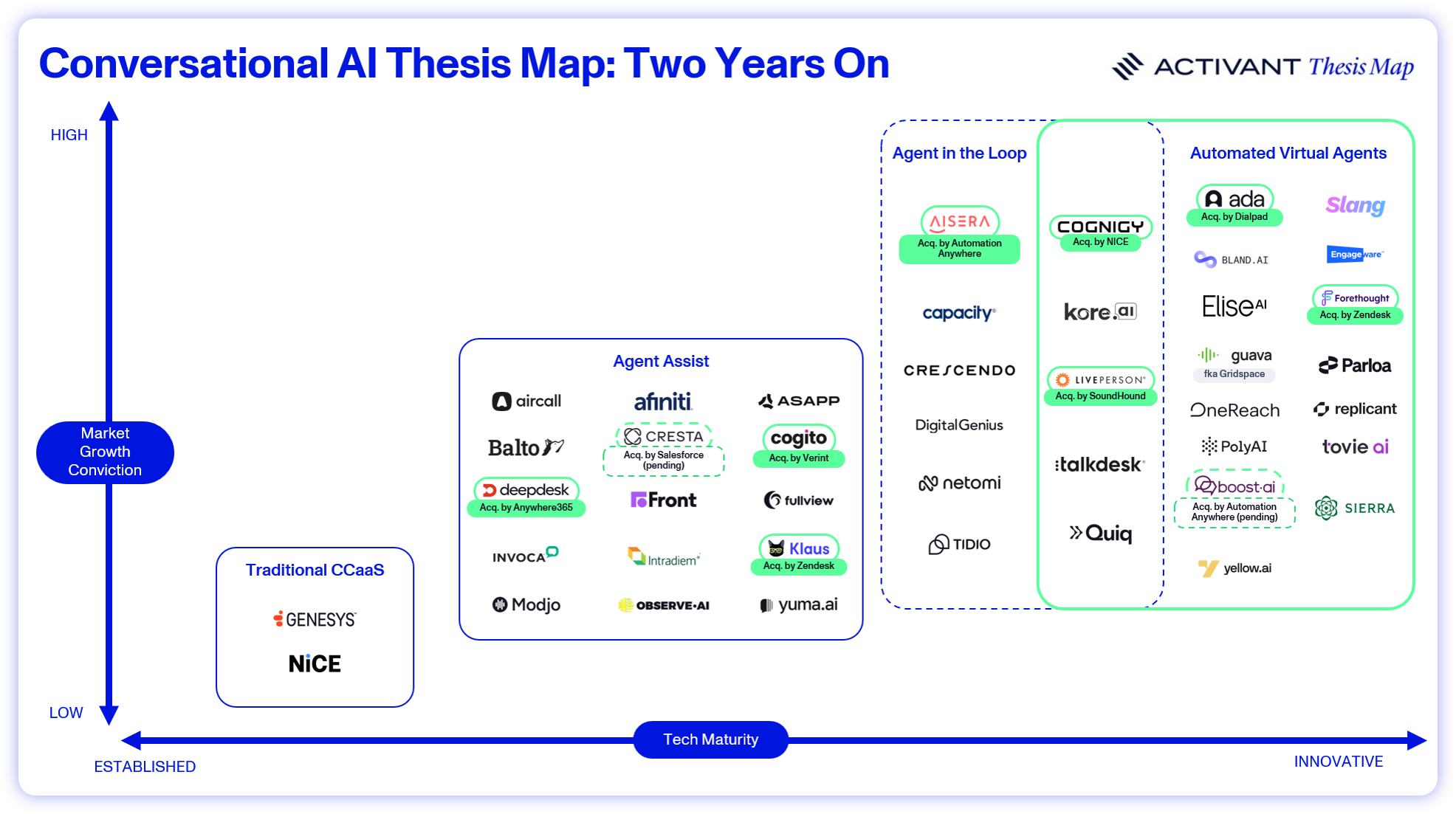
But look a little closer, and a more interesting pattern emerges: they’re using voice AI to extract greater value from workflows that are already digitized.
Same Conversation, Different Voice
Meanwhile, startups are finding opportunity in industries where digitization has previously lagged. One such example is the home services industry where a missed phone call means a lost job. Avoca, Netic, Probook, Elyos and Broccoli, are all going after some version of the same workflow: automating customer calls, appointment bookings, technician dispatch and estimate follow-ups. Meanwhile, Voice AI incumbent, ElevenLabs, launched an AI receptionist starting at just $29 per month, placing an inexpensive alternative in front of small business owners.5 While dispatching the right technician, handling exceptions and working inside of a contractor’s existing systems takes more than a convincing voice, founders will still have to explain why customers should pay substantially more than the price of a general AI receptionist.
What if the bigger opportunity isn’t using AI to speak on behalf of businesses, but using voice to capture what businesses have never written down?
The Data Hiding in Plain Speech
Healthcare offers an early proof point for the value in capturing spoken information. Abridge, the $5.3 billion ambient AI scribe has demonstrated that doctor-patient conversations can be transformed into structured clinical records. Beyond reducing administrative work, these tools make it possible to preserve clinical observations that were previously inconsistently recorded or lost between consultations. And that information can also be used for work that follows consultation like prior authorization and other revenue cycle processes.
Other industries are catching on – in field sales, Otto lets reps update CRM records through a phone call, while Supio connects client conversations to legal case files. The shift is from making existing documentation easier to recording information that might otherwise be lost entirely.
The Last Mile is Spoken
A mechanic notices an unusual vibration. A site supervisor explains why a delivery was delayed. An agronomist identifies early signs of crop disease. These observations are valuable but too often remain trapped in casual conversations, handwritten notes or workers’ memories. A new generation of voice-native startups is bringing them into software.
Tellia, which announced a $5 million pre-seed in September, is building around those habits in agriculture, turning farmers’ spoken observations and field activities into structured operational records.6 PropelMapper similarly converts agronomists’ voice notes into geolocated field reports, building a searchable history of conditions and interventions across individual fields.
In construction, Hank turns verbal jobsite updates into daily logs, Hardline captures information from team conversations and Opusense combines spoken observations with photographs to generate inspection reports.
The implications are especially compelling in maintenance-intensive industries. In aviation, Fleetcraft and Zymbly let technicians document findings, repairs and corrective actions through voice, contributing to an aircraft’s regulated maintenance history. In automotive repair, Bayworks connects spoken observations and video to vehicle diagnoses and repairs. And in manufacturing, YC-backed Pairio is tackling knowledge transfer in factories, letting technicians describe what they learned while fixing equipment so that someone else can retrieve it later.
Together, these companies offer something much more valuable than automated documentation. In cases where workers send voice notes from a field, describe a fault beside a noisy machine, or simply chat to a colleague, with little intention of producing a report, these companies are creating a digital record of how physical work actually happens, linked to specific assets, locations and outcomes.
The Next System of Record?
Existing software vendors have good reason to add voice themselves. Last month, Procore announced AI Go, a voice-first construction assistant, designed to let workers create daily logs, observations and requests for information through natural conversation.7 In industrial maintenance, Prometheus Group is similarly converting technicians’ spoken observations into structured records within existing asset management systems.8
For investors, these developments validate the demand but we should be careful about jumping from easier documentation to a data moat because not all voice-generated data is equally valuable. In many workflows, documentation already happens but only enough information is recorded to complete the task. A car mechanic might record ‘replaced the battery’ without noting that it had already been replaced six months earlier, only struggled to start on cold mornings or that this is the third Honda Civic to come in for battery related issues this month.
A transcript alone leaves plenty unresolved but when preserved and connected to outcomes, those details can reveal patterns that individual records cannot. Across thousands of repairs, software could identify which components fail most frequently, under what conditions and which interventions work best. What begins as a documentation tool could evolve into an intelligence layer that understands not just what happened, but why.
Salesforce’s Cresta deal shows us why an established system of record wants access to the conversations around it. Healthcare is seeing similar competitive pressure, with Epic, one of the largest electronic health record (EHR) providers in the US, developing its own ambient documentation capabilities. If incumbents can build voice intelligence directly into the systems they already own, where does that leave startups?
We see two potential paths to defensibility. The first is creating entirely new datasets, digitizing tacit knowledge and previously undocumented information, as Tellia is doing in agriculture. The second is owning what happens after the conversation, connecting observations and decisions to downstream workflows. Abridge is pursuing this path through its collaboration with Availity expanding into revenue cycle management, using consultation data to support prior authorizations and flag billing issues before claims are submitted.9 In both cases, the value extends far beyond the conversation itself. As voice becomes embedded in everyday workflows, it could become the missing write layer for the physical economy.
The first wave of voice AI taught software to speak. The next could teach it what businesses have never written down.
Footnotes
-
Salesforce, Salesforce Signs Definitive Agreement to Acquire Cresta, 2026 ↩
-
Zendesk, Zendesk Completes Acquisition of Forethought, 2026 ↩
-
Automation Anywhere, Conversational AI Is Finally Connected to the Work: Automation Anywhere to Acquire Boost.ai, 2026 ↩
-
Dialpad, Dialpad and Ada combining to build the agentic operating system for customer work, 2026 ↩
-
ElevenLabs, Introducing Reception, by ElevenAgents, 2026 ↩
-
Tellia, Tellia raises $5M to bring voice AI to the field, 2026 ↩
-
Procore, Procore Launches Voice-First AI Mobile App Built for the Jobsite, 2026 ↩
-
Prometheus Group, How AI Turns Spoken Field Observations into Complete Maintenance Notifications, 2026 ↩
-
Abridge, Abridge and Availity Collaborate to Redefine Payer-Provider Synergy at the Point of Conversation, 2026 ↩
Disclaimer: The information contained herein is provided for informational purposes only and should not be construed as investment advice. The opinions, views, forecasts, performance, estimates, etc. expressed herein are subject to change without notice. Certain statements contained herein reflect the subjective views and opinions of Activant. Past performance is not indicative of future results. No representation is made that any investment will or is likely to achieve its objectives. All investments involve risk and may result in loss. This newsletter does not constitute an offer to sell or a solicitation of an offer to buy any security. Activant does not provide tax or legal advice and you are encouraged to seek the advice of a tax or legal professional regarding your individual circumstances.
This content may not under any circumstances be relied upon when making a decision to invest in any fund or investment, including those managed by Activant. Certain information contained in here has been obtained from third-party sources, including from portfolio companies of funds managed by Activant. While taken from sources believed to be reliable, Activant has not independently verified such information and makes no representations about the current or enduring accuracy of the information or its appropriateness for a given situation.
Activant does not solicit or make its services available to the public. The content provided herein may include information regarding past and/or present portfolio companies or investments managed by Activant, its affiliates and/or personnel. References to specific companies are for illustrative purposes only and do not necessarily reflect Activant investments. It should not be assumed that investments made in the future will have similar characteristics. Please see "full list of investments" at activantcapital.com/companies/ for a full list of investments. Any portfolio companies discussed herein should not be assumed to have been profitable. Certain information herein constitutes "forward-looking statements." All forward-looking statements represent only the intent and belief of Activant as of the date such statements were made. None of Activant or any of its affiliates (i) assumes any responsibility for the accuracy and completeness of any forward-looking statements or (ii) undertakes any obligation to disseminate any updates or revisions to any forward-looking statement contained herein to reflect any change in their expectation with regard thereto or any change in events, conditions or circumstances on which any such statement is based. Due to various risks and uncertainties, actual events or results may differ materially from those reflected or contemplated in such forward-looking statements.